Swirly Line and Star Vector Elements: Graphics & Illustrations
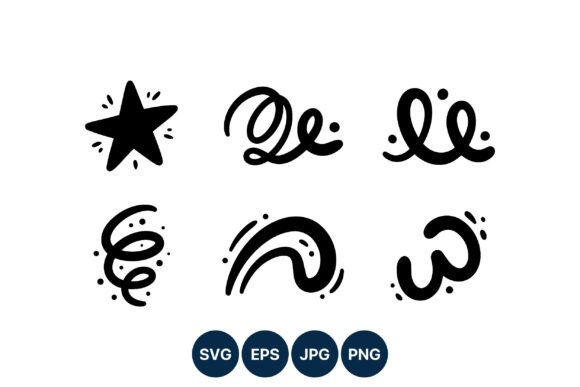
As a graphic designer who’s built brand identities for handmade businesses, launched seasonal print-on-demand collections, and crafted social media graphics for Etsy sellers and local boutiques, I opened Swirly Line and Star Vector Elements expecting charm—and found precision. This isn’t just decorative clipart; it’s a tightly curated Collection of black vector decorative elements including a star and various swirly line shapes with dot accents, presented in flat style on white background. The moment I unzipped the folder—SVGs cleanly layered, no raster artifacts, no hidden pixels—I knew this was built for real client work.
A First Impression That Sets the Tone
The mood is gentle but intentional: whimsical without being childish, organic without sacrificing structure. The swirls have rhythm—not chaotic loops, but confident, tapered curves that echo hand-drawn ink, yet retain crisp vector control. The star isn’t sharp or aggressive; it’s soft-edged, slightly asymmetrical, and grounded by subtle dot accents that add texture and visual pause. Together, they whisper “handmade business,” “curated boutique,” or “thoughtful seasonal campaign”—not corporate boardroom or tech startup.
Where It Shines in Real Client Projects
I recently scoped visuals for a small-batch lavender apothecary launching a spring gift set. Their packaging needed warmth, tactility, and quiet elegance—no loud gradients or busy patterns. Swirly Line and Star Vector Elements slotted in perfectly as a supporting brand element: scaled down along the bottom edge of a product label, repeated as a subtle border on a thank-you card, or enlarged as a hero graphic behind hand-lettered copy on Instagram posts. It elevated the entire visual hierarchy—not by shouting, but by adding breathing room and intention.
In practice, this asset performs exceptionally well across:
- Packaging design: As die-cut accents on kraft boxes or foil-stamped details on sticker sheets
- Printable design: For wall art bundles, planner stickers, or wedding invitation suites where cohesion matters
- Social media graphics: As framing devices for Canva templates or Pinterest pins—especially when paired with serif or script fonts
- Cricut project and sublimation design: SVG files scale flawlessly for vinyl cuts, iron-ons, and ceramic transfers
- T-shirt design and tote bag graphics: Works beautifully as a single focal motif or grouped into a repeat pattern
- Editorial design and blog visuals: Adds visual interest to otherwise text-heavy layouts without competing with content
Where to Use It With Intention—Not Assumption
This isn’t a universal fix. Its strength lies in context—and its limitations are just as instructive. Avoid dropping Swirly Line and Star Vector Elements into:
- Small-scale applications like favicon icons or tiny app UI elements—detail loss is noticeable
- Crowded layouts where multiple decorative layers compete (e.g., layered over textured photos or dense patterned backgrounds)
- Minimalist branding systems requiring strict geometric restraint or ultra-clean sans serif pairings
- Professional corporate materials—law firms, fintech dashboards, medical reports—where visual trust hinges on neutrality and clarity
It also demands contrast awareness. On light backgrounds? Perfect. On dark or mid-tone substrates? Test first—some swirls fade if not manually recolored or given subtle drop shadows. And while the flat black style reads beautifully next to handwritten fonts and warm serifs, it can visually “fight” against bold display fonts or tight monospaced type—so always preview in real composition.
Designer Notes You’ll Actually Use
Before clearing Swirly Line and Star Vector Elements for client delivery, I run these checks:
- Test in black and white: Confirms readability and tonal balance—no hidden gray edges or anti-aliasing ghosts
- Preview at actual size: Place it on a real product mockup (mug, sticker sheet, tote bag)—not just in Illustrator artboard
- Check SVG editability: Open each file in Illustrator—verify anchor points are clean, strokes are editable, and grouping logic makes sense for future tweaks
- Compare font pairings: Try it beside your go-to serif (e.g., Playfair), sans serif (e.g., Inter), script (e.g., Pacifico), and display (e.g., Bungee) to gauge harmony
- Confirm commercial license: Especially critical for print-on-demand sellers and digital product creators—this asset includes full commercial rights, so it’s safe for Etsy product listings and Canva template resale
- Review print output: Run a test print on uncoated paper—swirl thinness and dot clarity hold up well, but avoid pushing stroke weight below 0.25pt
Why It Earns a Spot in My Design Assets Toolkit
In a sea of generic illustration packs, Swirly Line and Star Vector Elements stands out because it balances aesthetic specificity with functional flexibility. It doesn’t try to be everything—it leans into its gentle, handmade character, and that focus makes it more valuable, not less. For creative marketplace sellers building cohesive digital product bundles, for bloggers designing branded printable planners, or for small business owners refreshing their packaging before holiday season—it delivers polish without pretense.
It supports emotional appeal without sacrificing professionalism. It enhances audience engagement by adding warmth and approachability—key for wellness brands, craft collectives, and local event promotions. And because it’s delivered as scalable SVG + standard formats, it integrates seamlessly into modern design workflows, whether you’re prepping files for Cricut Design Space or exporting assets for a Shopify store banner.
If your client project lives at the intersection of authenticity and execution—if it values tactile feeling but demands pixel-perfect delivery—then Swirly Line and Star Vector Elements isn’t just suitable. It’s strategic.