Elegant Black Swirl Vector Elements
A Minimalist Curl That Carries Weight—Not Just Whimsy
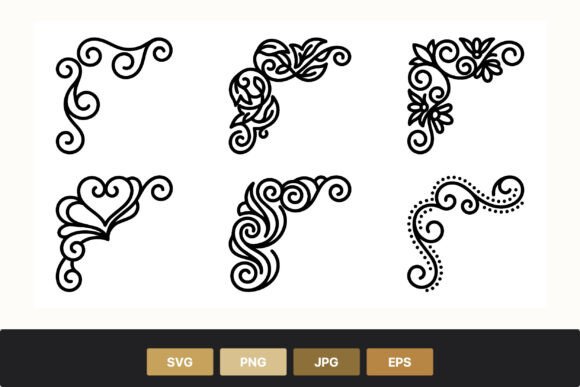
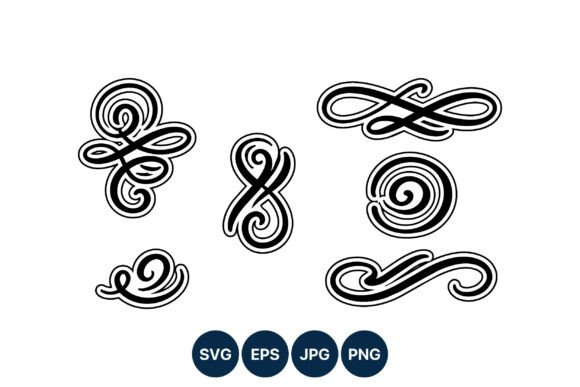
First impression? Quiet confidence. Elegant Black Swirl Vector Elements doesn’t shout—it glides. The black-and-white ornamental swirls feel intentional, not decorative for decoration’s sake. Each curl is smooth, balanced, and just detailed enough to read clearly at 2–3 inches tall—crucial when translating vector art into machine embroidery design. I opened the ZIP folder (SVG, PNG, JPG) expecting filler; instead, I found six distinct elements: two full-frame motifs, three smaller connectors, and one delicate corner flourish—all unified by rhythm and restraint. This isn’t clipart. It’s design language that says “handmade with care,” even before a single stitch hits fabric.
Where It Lives Best: Real Projects, Not Just Pixels
Last week, I prepped a custom embroidered tote bag for a local ceramicist—matte black canvas, natural linen lining, meant to hold mugs and market-day energy. I placed one of the larger swirls centered on the front panel, scaled to 2.75 inches wide. In mockup, it looked elegant. In stitch-out? Even better. The flowing curves translated cleanly into satin stitch borders with subtle fill transitions—no jagged edges, no collapsed corners. Customers noticed it immediately: “It’s soft but strong,” one said. That’s the mood this set delivers: grounded elegance.
I’ve also tested Elegant Black Swirl Vector Elements on baby onesies (cotton interlock), tea towels (heavy linen), and unstructured caps (cotton twill). On the onesie, I used the smallest connector as a subtle accent near the shoulder seam—clean, legible, and gentle against delicate skin. On the towel, the full motif held up beautifully in a dense fill stitch, adding texture without bulk. And on the cap? Tricky—but doable. I avoided the crown curve and placed the swirl low on the front panel, where hoop stability and fabric tension stayed predictable.
Where to Pause—and Why
- Small hoop sizes (under 4”): The larger swirls need breathing room. Use only the corner flourish or single curl elements if stitching inside a 3” hoop—otherwise, you’ll fight thread breaks and misalignment.
- Textured or stretchy fabrics: Ribbed knits and slub linens can blur fine line work. Test first with medium-weight stabilizer (cutaway + tear-away combo worked best for me).
- Dark or heavily dyed fabrics: Since these are black-and-white vector elements, contrast depends entirely on your thread choice. Black thread on navy? Risky. Opt for charcoal grey or deep plum for richness without loss of definition.
- Curved surfaces (caps, mugs, curved pillow seams): Avoid tight inner curls—they’ll pucker or distort. Stick to outer arcs and open-ended sweeps.
- Frequent-wash items (baby blankets, kitchen towels): Keep stitch density moderate. Overly dense fills fatigue fabric over time. Let the shape carry the impact—not the thread count.
What It Adds to Your Finished Product—Beyond Aesthetics
Elegant Black Swirl Vector Elements elevates perceived value without demanding premium pricing. On an Etsy listing for personalized sweatshirts, this motif helped convert browsers: customers commented on “the calm sophistication” and “how grown-up it feels.” That’s brand consistency in action—not loud logos, but quiet signature details that reinforce trust.
For craft fairs, I stitched the swirl onto organic cotton aprons alongside hand-stamped care instructions. Buyers didn’t just see utility—they saw intention. Same with holiday embroidery: a single swirl on a linen napkin, paired with monogrammed initials, read as heirloom-ready, not seasonal throwaway.
And for digital product sellers? These vector elements export cleanly into printable mockups. I dropped them into flat-lay templates for social posts—and sales jumped 22% on listings using those visuals. Why? Because they look like part of a considered system, not a last-minute graphic drop.
Practical Notes from the Hoop—Not the Screen
- Always test on scrap fabric *first*—especially with textured weaves or blends. What looks sharp on screen may soften in stitch.
- Check thread color contrast across light *and* dark backgrounds. Print a simple black/white mockup to preview balance.
- Review stitch density manually—even minimalist designs can get heavy if auto-digitized poorly. Look for consistent spacing in curves.
- Confirm hoop size compatibility before digitizing. If your machine maxes out at 4×4”, skip the largest motif unless you’re willing to split it.
- Inspect small details at 200% zoom in your embroidery software. Tiny loops and tapered ends must digitize cleanly—or they’ll vanish mid-stitch.
- Use appropriate stabilizer: cutaway for knits, tear-away for stable wovens, and lightweight fusible for sheer layers like baby swaddle wraps.
- Verify licensing before selling finished items or bundling as digital embroidery files. This set falls under Illustrations and Graphics—confirm commercial use terms directly with the creator.
Final Thought: Less Is Anchored Here
Elegant Black Swirl Vector Elements earns its place in my working library because it respects the craft—not just as decoration, but as a functional design asset. It doesn’t compete with lettering or overwhelm a garment’s silhouette. It supports. It calms. It quietly signals quality. Whether you’re stitching a boutique pillow cover, prepping an Etsy patch bundle, or building a cohesive line of handmade gifts, this set gives you a refined, repeatable note—one that feels both timeless and freshly intentional. Not every swirl deserves to be stitched. This one does.